
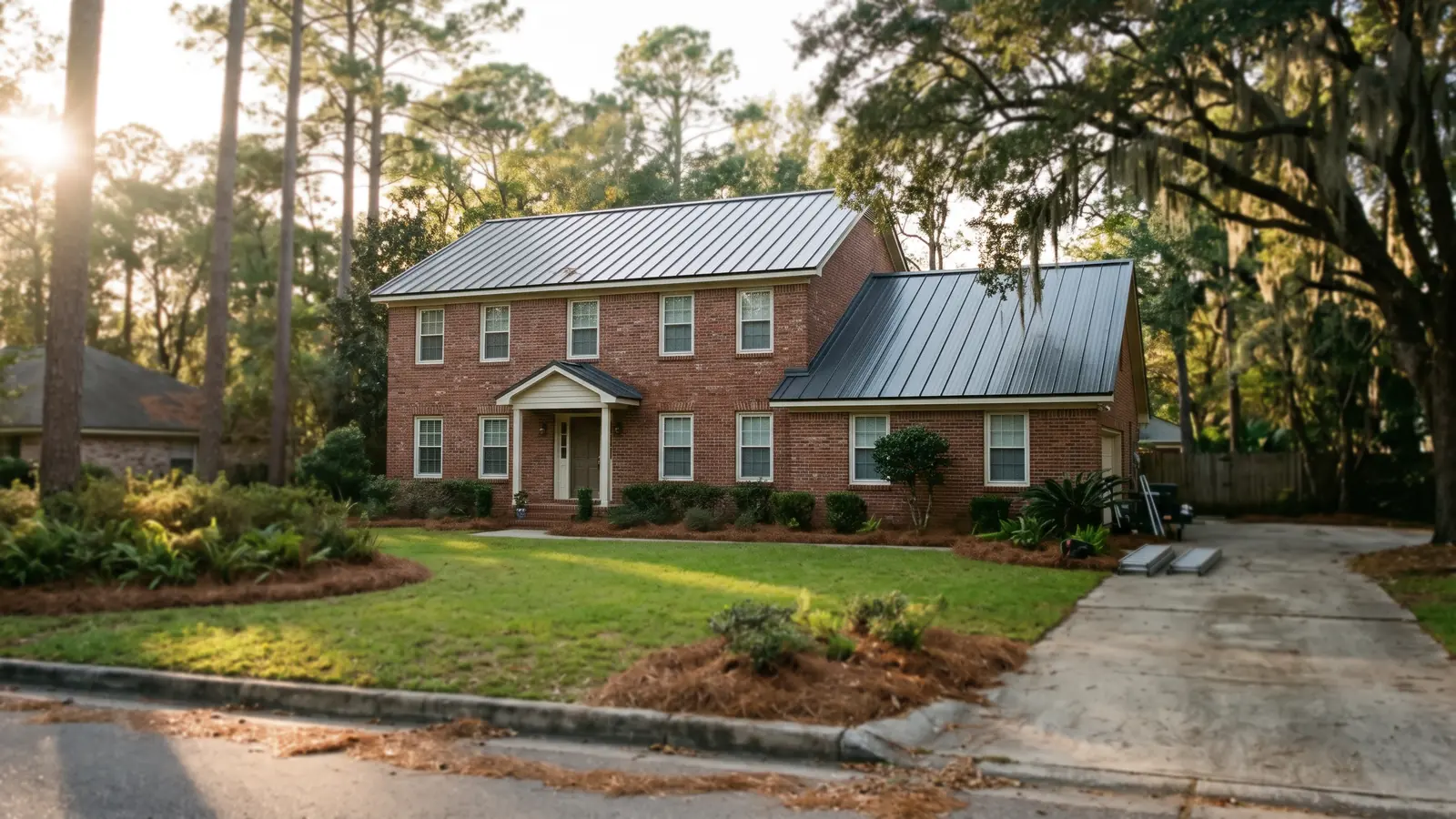
Standing Seam Metal Roof Profiles in Tallahassee
Standing seam covers a few different systems that look alike from the street. They differ in how the seam closes, how the panel is held down and how low a pitch they can handle.
Mechanical-Lock (Double-Lock) Seams
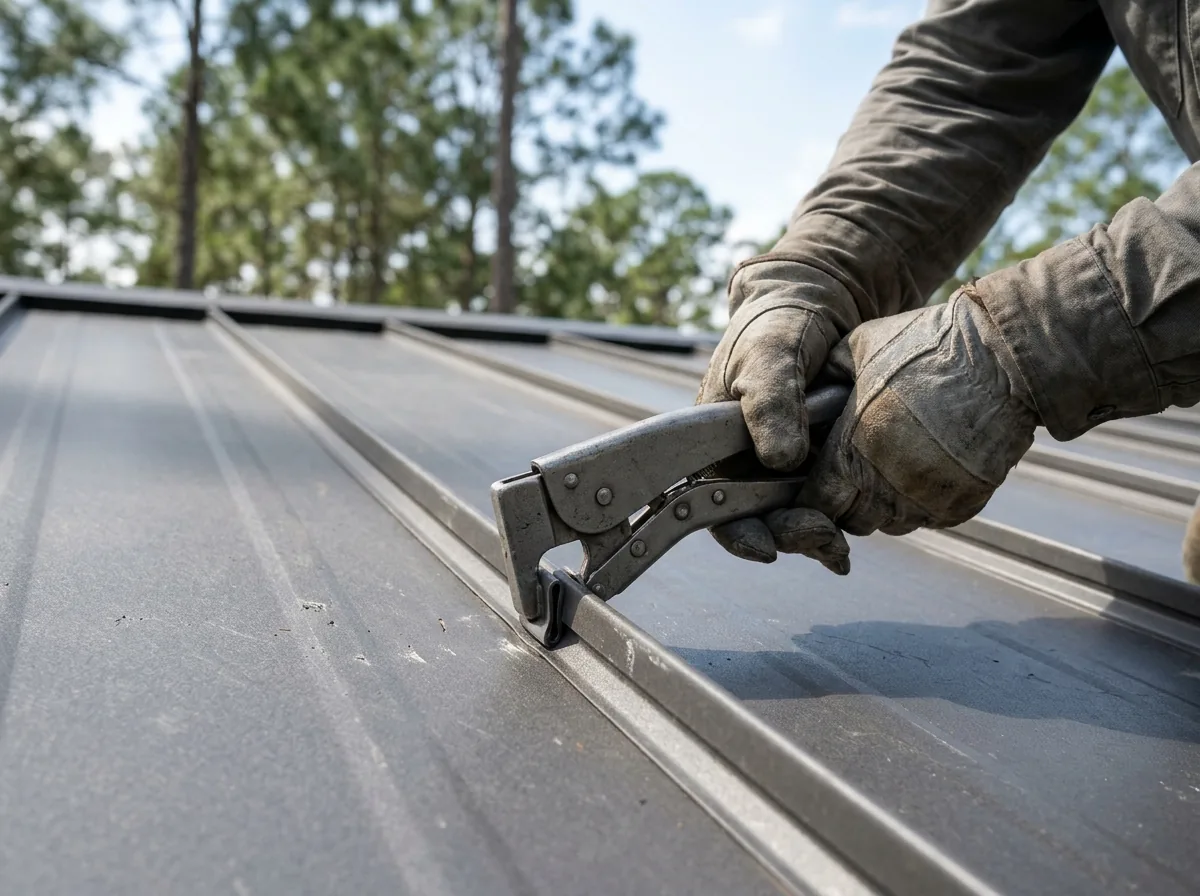
The clip hooks over one panel's leg, the next panel's leg covers it, and a hand or robotic seamer folds the two together. A single lock is one 90-degree fold. A double lock is two folds, 180 degrees, and is less likely to come unseamed. One fastener maker credits mechanical seams with the best wind uplift values of the standing seam types. Some profiles are engineered to span open framing without a deck.
- Lowest pitch, one 2-inch profile: 1/2 in 12 in steel, with continuous in-seam sealant below 2 in 12 (manufacturer data)
- Code floor for standing seam: 1/4 in 12 (FBC 1507.4.2)
- Best fit: low porches, long runs, and buildings that need the highest tested uplift
Snap-Lock Panels
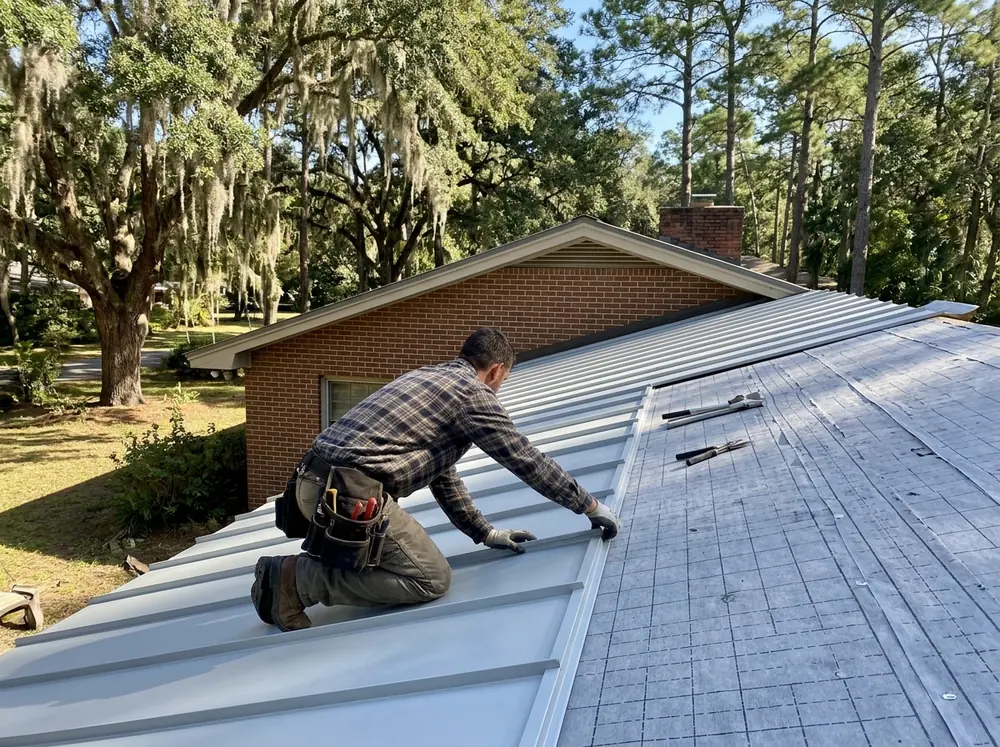
Snap-lock panels hold down with hidden clips like mechanical-lock panels, but the legs press together by hand with no seaming tool. That cuts labor. One supplier doesn't recommend most snap-lock profiles at or below 3 in 12, though some are tested down to 2 in 12. The seam is boxier and wider than a folded seam. One fastener maker describes snap-lock as a fixed system without room for heat movement.
- Typical lowest pitch: above 3 in 12; a few profiles to 2 in 12 (manufacturer data)
- Best fit: steep and mid-pitch house roofs
Nail-Strip Panels
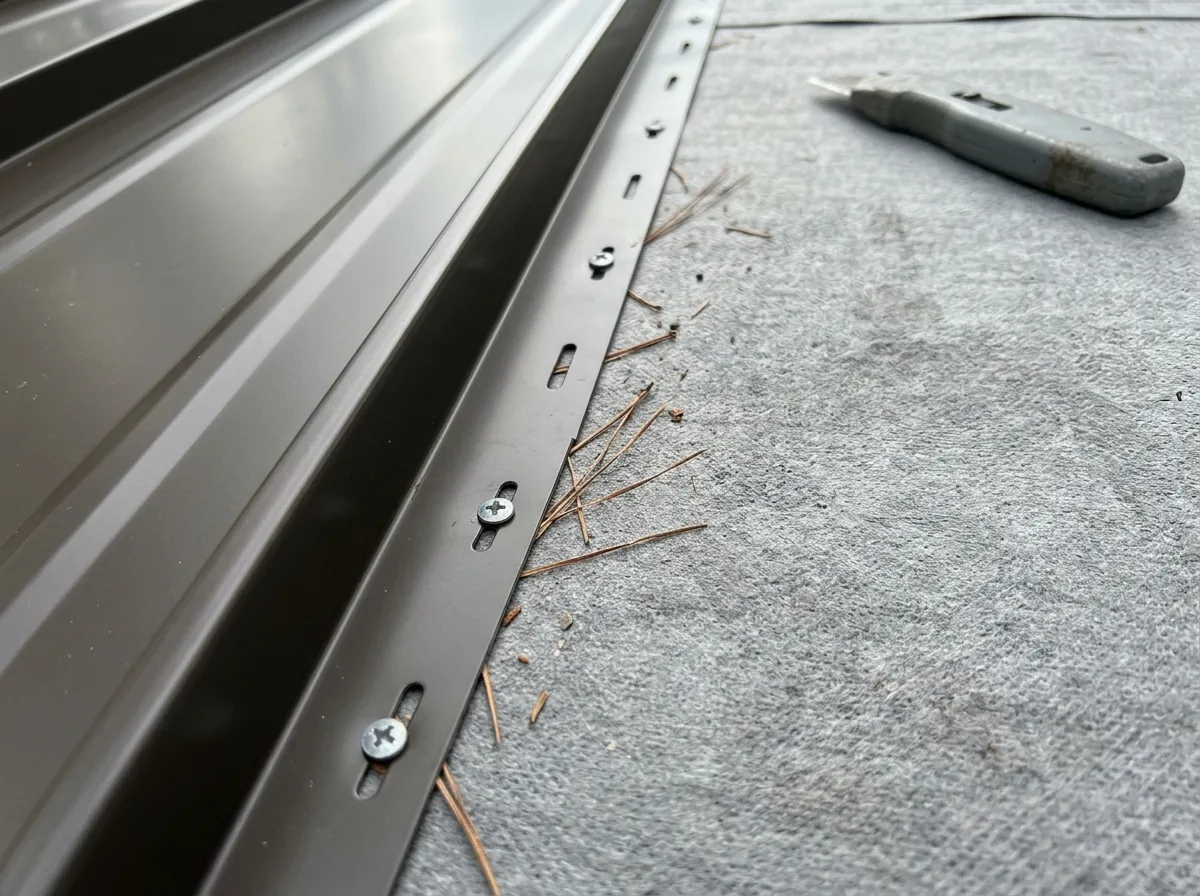
Nail-strip (fastener flange) panels skip clips. Screws go through a slotted flange along one edge, and the next panel snaps over to hide them. They're the cheapest standing seam option and the quickest to install, but there are tradeoffs that matter in a storm-prone city. The roof is held only by those fastener heads, panels follow every wave in the deck (which can show as oil canning), and one supplier says most aren't engineered and doesn't recommend them in hurricane or tornado country. Leon County's design wind speeds are on the installation page.
- Lowest pitch: 3 in 12 (manufacturer data)
- Longest panel: about 25 feet (manufacturer data)
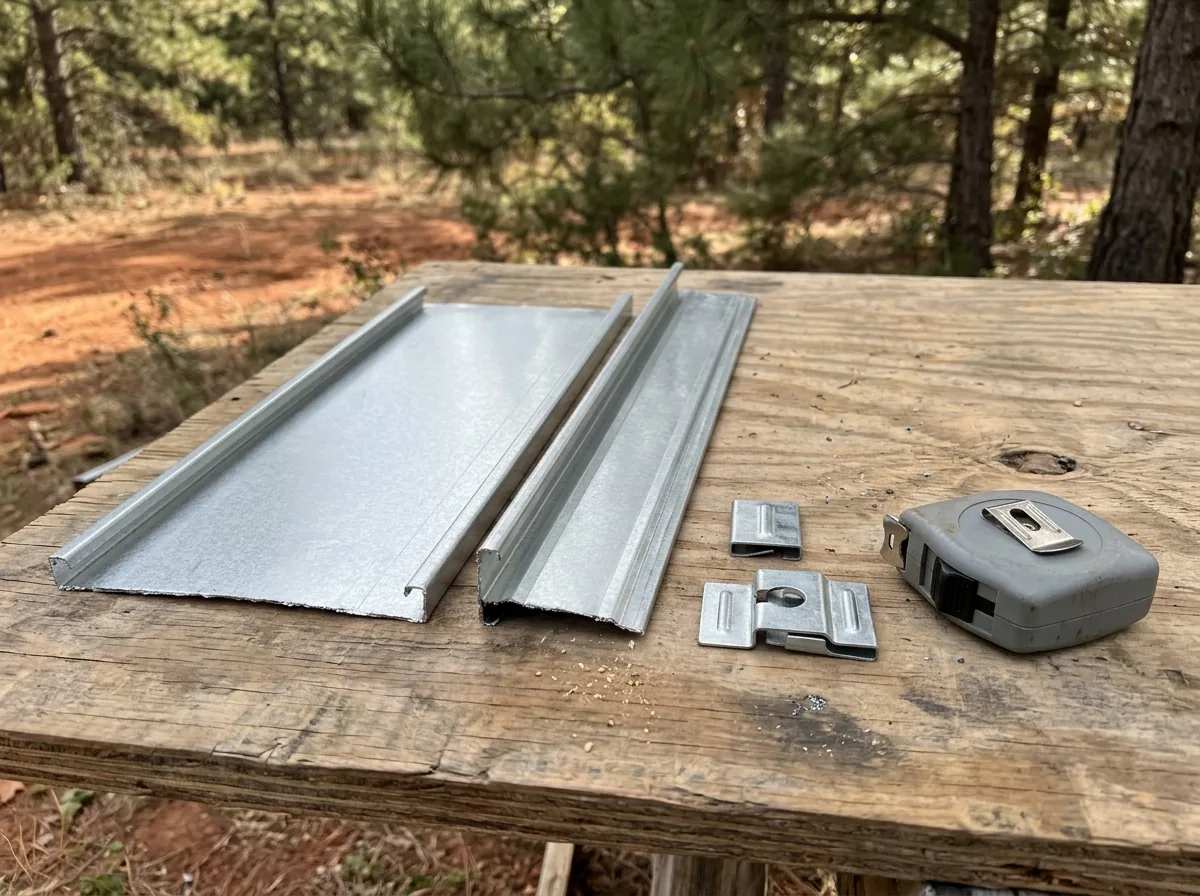
Panel Width, Rib Height and Clip Types
Panels run 12 to 24 inches wide. Narrow panels use more pieces and labor, and wide panels go on faster, so they usually cost less. Seam heights run from about 1 inch on nail-strip profiles to 2 inches on heavy mechanical-lock ones. Clips come fixed or floating. Floating clips let the panel slide as it heats in the afternoon and cools at night, and one supplier calls for them on any panel longer than 25 feet. Fixed clips suit short runs.
- Example widths: 16 in. aluminum or 18 in. steel on one snap-lock profile; 16 in. on one 1-inch nail-strip profile (manufacturer data)
- Example metal: 22 to 24 gauge steel or 0.032 to 0.040 in. aluminum (manufacturer data)
PVDF (Kynar) and SMP Finishes
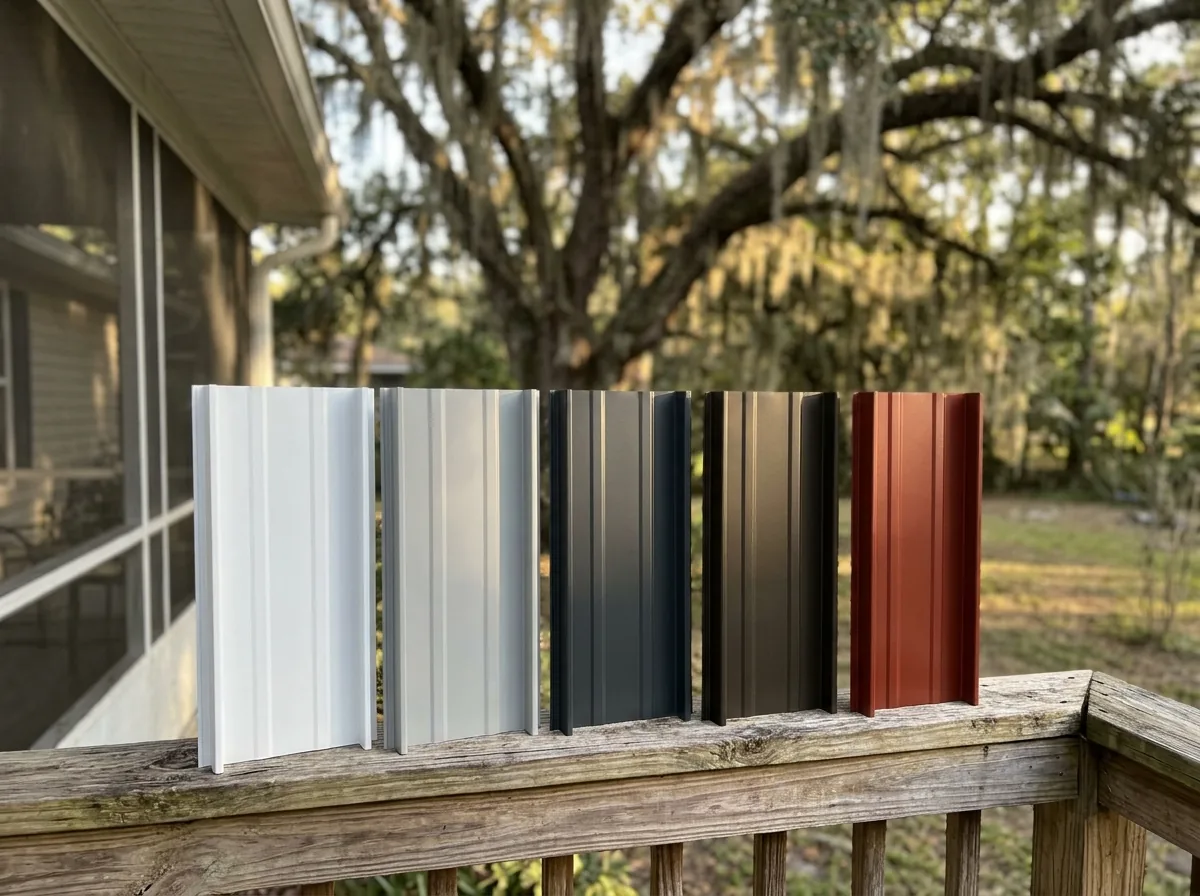
The two common factory paint systems are SMP (silicone-modified polyester) and PVDF (often sold as Kynar 500). SMP costs less. PVDF holds its color better and resists chalking, the white powdery breakdown of the paint. Warranties for both often run 40 years for film adhesion (no cracking or peeling) and 30 years for chalk and fade, but SMP is allowed to chalk and fade more inside those 30 years. Color matters too. Deep reds and blues show fading more than white does. One manufacturer's PVDF warranty also leaves out corrosion of the steel underneath, so the finish warranty isn't a roof warranty.
Why Tallahassee homeowners call Tallahassee Metal Roof Co.
- Free referral, no charge to homeowners
- Your request reaches a single metal roofing contractor, not a list
- Ask for panel, gauge and Product Approval number in writing
- Free, no-obligation estimate from the roofer
Standing Seam Gauge: 22, 24, 26 or 29
Gauge runs backward: the lower the number, the thicker the steel. The statewide Florida Building Code sets no minimum steel gauge for metal panels. It sets a coating instead (AZ50 Galvalume or G90 galvanized), plus 0.024 inch for roll-formed aluminum. So gauge comes down to the product approval and the quote. HomeGuide's material prices and suggested uses by gauge:
| Gauge | Material price per sq ft | Suggested use |
|---|---|---|
| 29 | $1 to $3 | Small barns and sheds in mild climates |
| 26 | $1.50 to $5 | Houses in mild to moderate climates |
| 24 | $3 to $7 | Homes and commercial roofs where storms are severe |
| 22 | $4 to $8 | Commercial and high-end residential roofs |
HomeGuide says houses mostly get 24 or 26. On nail-strip panels a thinner sheet also weakens the snap between panels, one supplier notes. Ask for the gauge and the coating weight on the quote, in writing.
Standing Seam Metal Roof Cost in Tallahassee
The national guides put standing seam between about $8 and $24 a square foot installed. Modernize's range is $8 to $14, HomeGuide's $9 to $16 and Forbes's $9 to $24. Copper and zinc push HomeGuide's figure to $11 to $32. The only local number is Homeyou's Tallahassee estimator, which prices a small 1,282 sq ft roof at about $8 to $10 a square foot. Treat it as one data point, not a local average.
Inside those ranges, the seam type moves the price. Mechanical-lock costs most because seaming takes extra labor and time. Snap-lock sits in the middle, and nail-strip costs least because it has no clips. Aluminum adds about $1 to $2 per square foot over Galvalume steel in Modernize's figures. After that, pitch, valleys, dormers and any tear-off set the number.
See metal roof replacement for tear-off and permit costs.